Forex for beginners becomes a clear step-by-step path from first chart to first managed trade
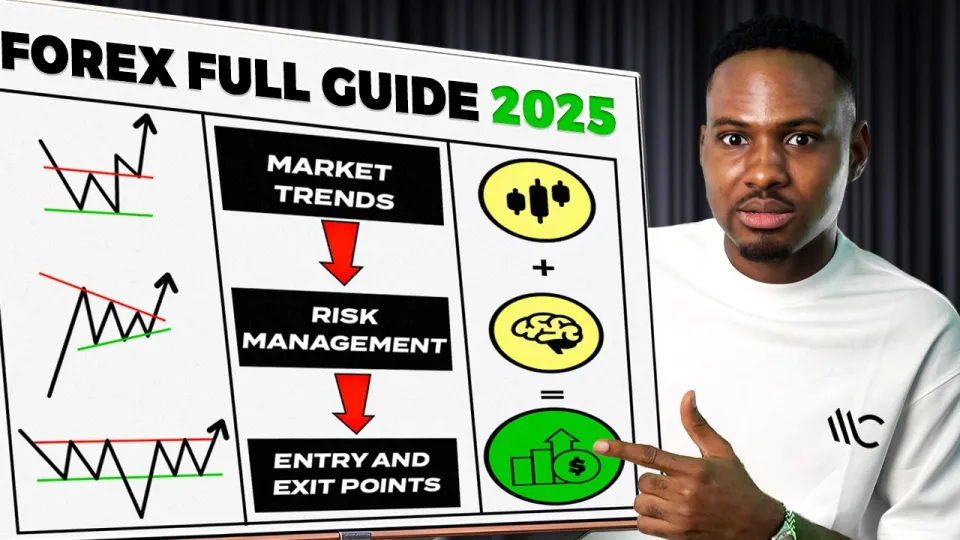
Video: How To Start Forex Trading For Beginners’ 2025 (Full Course)
Need articles like this for your video? They help promote it on YouTube and Google — order them in the Telegram bot @sat_sit_bot. The bot writes and publishes the articles itself (with your YouTube video embedded) on popular topical websites (no ads). Free trial — 50 articles.
· based on the channel Jeffrey Benson Forex
Forex trading for beginners is the process of learning how currency pairs are quoted, choosing a regulated broker and charting platform, practising on a demo account, and only then risking small, pre-calculated amounts per trade. The core skill is not prediction but risk control: a defined stop loss, a position size capped at roughly 1–2% of the account, and a written plan repeated until it becomes routine. A structured starting point is the free beginner course from Jeffrey Benson Forex, and the author's student programme is available at Fire Pips FX plans.
What forex trading actually is and how currency pairs are priced
Forex is the global market for exchanging national currencies, and every price you see is a ratio between two of them. A quote like EUR/USD = 1.0850 means one euro buys 1.0850 US dollars; the first currency is the base, the second is the quote, and the change in that number is what a trader tries to capture.
The market is decentralised: trades run through a network of banks, brokers and liquidity providers rather than a single exchange, so there is no official closing bell. It trades 24 hours a day, five days a week, which is convenient for people with day jobs but also means prices can move while you sleep.
Three structural facts shape every beginner decision:
- Leverage is built in. A broker may offer 1:100 or more, so a small deposit controls a large position. That magnifies both gains and losses, and it is the single biggest reason new accounts blow up.
- Spreads and commissions are the real cost. The difference between bid and ask is charged on every trade; on a 1.0-lot EUR/USD position a 1-pip spread is about $10, so scalping 20 trades a day quietly hands a large share of the account to the broker.
- Major pairs behave differently from exotics. EUR/USD, GBP/USD, USD/JPY and USD/CHF have the tightest spreads and the deepest liquidity, which makes them the sensible first classroom. Exotic pairs such as USD/TRY or USD/ZAR can gap violently and are not beginner material.
How the trading day is divided into sessions
Market behaviour changes with the clock, and beginners do better when they trade one consistent window instead of the whole day. The four sessions are Sydney (roughly 22:00–07:00 UTC), Tokyo (00:00–09:00 UTC), London (07:00–16:00 UTC) and New York (12:00–21:00 UTC), with the exact boundaries shifting when daylight saving changes.
The London–New York overlap, roughly 12:00–16:00 UTC, is the busiest stretch of the day: both major financial centres are active, spreads are tight and ranges expand. The late New York to early Sydney stretch is the opposite — thin liquidity, wide spreads and erratic moves that punish tight stop losses. Writing the session times into a notebook, as several viewers of the course recommend, is more useful than memorising them once.
The tools a beginner needs before risking money
A beginner needs four things: a charting platform, a broker account, a demo account and a journal. Nothing else is required to start, and buying extra indicators or signal subscriptions before those four are in place is a distraction.
Charting platform. MetaTrader 4 or MetaTrader 5 is the standard choice because most brokers connect to it directly and it includes order execution, watchlists and basic indicators. TradingView is the popular alternative for cleaner charting and drawing tools. Pick one and learn its order types — market, limit, stop and stop-loss — before adding anything else.
Broker. The course recommends Assex Markets, with registration through https://my.assexmarkets.com/auth/register?partner_code=1699134 and MT5 linking explained in the author's setup video. Whatever broker you choose, verify three things yourself: where it is regulated, what the all-in cost is (spread plus commission plus swap), and how fast withdrawals are processed. A broker that cannot be checked against a public regulator is not a candidate.
Demo account. Trade the same instrument, timeframe and position sizing you intend to use live, for at least 30–50 trades. The goal is not profit but proof that you follow your own rules when nothing is at stake.
Journal. Record entry, exit, stop distance, reason for the trade and the emotion you felt. After 20 entries, patterns appear — usually that the unplanned trades, not the strategy, are the problem.
A simple starter kit therefore looks like this: MT5 or TradingView on desktop plus mobile, one regulated broker account, one demo account, one spreadsheet, and one pair (EUR/USD) on one timeframe.
A basic strategy foundation that survives contact with the market
A workable beginner strategy is a repeatable set of conditions for entry, exit and risk, written down in advance so that decisions are not made in the heat of a live candle. The course builds this foundation before showing order placement, and that order matters: strategy first, execution second.
The components are always the same, whatever the style:
- Direction filter. Decide whether you are trading with the higher-timeframe trend or fading a range. A common beginner approach is to mark the daily trend, then look for entries on the 1-hour or 4-hour chart in that direction.
- Entry trigger. One clear, objective signal — a break of a recent swing high, a pullback to a moving average, a rejection candle at a marked level. One signal, not five stacked indicators that all say slightly different things.
- Stop loss. Placed where the trade idea is proven wrong, not at a round number you can afford. The distance in pips is what determines position size.
- Target and reward-to-risk. A minimum of 1:2 reward-to-risk means a strategy winning 40% of the time can still be profitable; at 1:1 it usually cannot after costs.
- Position sizing. Risk 1–2% of equity per trade. If the stop is 25 pips away and the account is $1,000 with 1% risk ($10), the correct size is roughly 0.04 lots on EUR/USD, where one pip on 0.01 lots is about $0.10.
Placing a first trade without skipping a step
The first live trade should be small, planned and boring — the point is to execute the process correctly, not to make money. After the analysis is done, the mechanics are short:
- Confirm the pair, direction and the level that invalidates the idea.
- Calculate lot size from the stop distance and the fixed risk amount.
- Set a pending or market order, then immediately attach the stop loss and take profit.
- Check the position on the platform — entry, stop, target and margin level — before walking away.
- Log the trade in the journal the same day, including a screenshot of the setup.
One practical warning: check the economic calendar before entering. A rate decision, CPI release or Non-Farm Payrolls print can move a pair 50–100 pips in minutes and jump straight through a stop loss, filling you at a worse price than planned.
Common beginner mistakes and how to neutralise them
Most beginner accounts fail for behavioural reasons rather than analytical ones, and the same handful of errors repeat. The course dedicates a full section to them, and the viewer comments confirm the pattern — risk management is the part people say they could not figure out on their own for years.
- Overleveraging. Trading 1.0 lots on a $500 account means a 50-pip move wipes it out. Fix: calculate size from risk, never from available margin.
- No stop loss, or moving it. Widening a stop to avoid a loss turns a small planned loss into an account-ending one. Fix: the stop is set at entry and is not touched.
- Revenge trading. Doubling size after a loss to win it back is the fastest route to zero. Fix: a daily loss limit, for example two losing trades and the platform closes for the day.
- Strategy hopping. Switching systems after three losses means never collecting enough data to judge any of them. Fix: a fixed sample of at least 30 trades before evaluating.
- Skipping the demo. Going live to "feel real emotion" usually means paying tuition at full price. Fix: demo until the process is automatic, then live with the minimum size.
- Following signals blindly. Copying trades without understanding the risk behind them transfers someone else's position size onto your account. The course's free daily signal channel at https://t.me/firepipsignals and the premium group via https://t.me/jeffreybenzhelpbot are useful for study, but the risk calculation still belongs to you.
Questions beginners keep asking
New traders tend to worry about the same few things before their first trade, and the answers are more practical than motivational. The recurring themes are time commitment, capital, the demo-versus-live question and how long profitability actually takes.
On time: one to two focused hours a day is enough to learn a single setup on a single pair; the constraint is consistency, not screen time. On capital: many brokers open accounts from $10–$100, but a realistic starting deposit is one you can lose without changing your life, because the first months are tuition. On the demo question: the demo teaches mechanics and rule-following, while live money teaches emotional control — use the demo to build the process, then go live at minimum size. On timelines: expect several months of deliberate practice before results stabilise, and judge yourself on rule adherence rather than monthly profit.
Useful links
- Student programme and course plans: https://firepipsfx.com/plans
- Free daily signal channel: https://t.me/firepipsignals
- Broker registration used in the course: https://my.assexmarkets.com/auth/register?partner_code=1699134
- Premium signal group access: https://t.me/jeffreybenzhelpbot
The realistic path from here
Forex rewards process discipline far more than prediction, and the sequence that works is unglamorous: learn how pairs are priced, pick one regulated broker and one platform, write a single strategy with fixed risk, prove it on a demo, then go live with 1–2% risk per trade and a journal open beside the chart. The Jeffrey Benson Forex full course covers exactly that arc, from market mechanics through tools, strategy and order placement to the mistakes that end most beginner accounts. If you want structured guidance rather than scattered videos, the student plans at Fire Pips FX are the author's own next step. Treat the first year as skill acquisition, keep position sizes small, and let the journal — not the profit and loss number — tell you whether you are improving.
Key takeaways
- Forex is an over-the-counter market where currencies are quoted in pairs such as EUR/USD; there is no single central exchange.
- Four sessions — Sydney, Tokyo, London and New York — overlap and set the liquidity and volatility window a beginner should trade.
- A working setup needs a charting platform (MT4/MT5 or TradingView), a regulated broker account, a demo account and a trading journal.
- Risk per trade is normally capped at 1–2% of account equity, with position size calculated from stop distance, not from lot-size habit.
- Most beginner losses come from overleveraging, trading without a stop loss, revenge trading after a loss and skipping the demo phase.
Source: How To Start Forex Trading For Beginners’ 2025 (Full Course) · Markdown version
Questions & answers
How much money do I need to start forex trading?
Many brokers open accounts from $10–$100, but the amount matters less than the risk per trade. With 1% risk, a $500 account risks $5 per trade, which is workable on micro lots. Start with capital you can afford to lose entirely, because the first months function as paid practice.
How long does it take to become profitable in forex?
There is no fixed timeline, but most traders need several months of deliberate practice — a written strategy, a demo phase and at least 30–50 logged trades — before results stabilise. Judge progress by how consistently you follow your rules rather than by monthly profit.
Should I trade a demo account or go live right away?
Use the demo to learn platform mechanics and to prove you can follow your own rules without emotion, typically for 30–50 trades. Then move to a live account at minimum position size, because only real money teaches emotional control.
Is copying signals a good way to start trading forex?
Signals can be useful for studying how experienced traders structure entries and exits, but copying them blindly imports someone else's risk onto your account. Understand the stop distance and position size behind each idea, and keep your own risk limit regardless of who posted the trade.